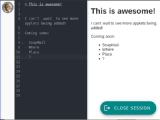
I just realized that Behavior Driven Development is very similar to double entry book-keeping in accounting!
Well, git definitely takes some gitting used to.
My situation is using git with three team members and a private shared repository that we all pull from and push too. Additionally our project has a submodule that lives on a public git-hub repository (metaform).
So here are some things I’ve learned:
- Use rebase. Here’s how:
- Rebase doesn’t work on “dirty” working tree. So you must, either:
- Add and commit all you changes.
git commit -a -m 'all my changes'(assuming that your ok committing them in a single batch). or - Stash your changes away
git stash(But don’t use stash if you have made changes in your submodule ! It’ll stash the changes away, but it gets very grumpy when unstashing later.)
- Add and commit all you changes.
- Fetch the changes:
git fetchthis should copy the changes from the remote branch (I assume your tracking the defaults here from the clone origin) - Now to rebase:
git rebase origin/masterIf you do a git log you should now see your checked in changes at the top of the tree, not somewhere near the bottom where they would be if you had just done a pull. - If you stashed above, then you need to unstash with
git stash apply
- Rebase doesn’t work on “dirty” working tree. So you must, either:
-
Submodules that are in active development can be a pain. Here’s a gotcha that gotme: When you have made a change to a submodule, checked it in and pushed it, you still need to add this change into your containing repository and commit that, and then do a
git submodule updateThis is all well documented, but lets take a concrete example. My submodule is a rails plugin. So just after committing the change in my submodluegit statusshows thatvendor/plugins/mypluginis modified. So I use my shell’s file completion to add that folder. This gets me:git add vendor/plugins/myplugin/notice the trailing slash. This is the gotcha. That causes git add to add all of the contents of the directory as if you wanted to track them directly instead of through the submodule. Erase that trailing slash!
Well, I’ve officially joined the git bandwagon. I’ve put metaform up on github (the open money projects will come soon, but I think probably on gitorious); I’ve been reading tons of articles about git; I installed it on Tiger (use MacPorts) and Leopard (install from source with these instructions but use 1.5.5); and now I’m blogging about it. The most interesting article so far on git, has made me realize how closely related it is to the mesh and churn… Quite interesting!
I’m in mexico, and it’s the start of the third day of the open money intensive. This is an incredible experience of the expansion of the open money vision that’s been in gestation for so long and is now being birthed. More soon!
I’m very grumpy because some spammers have been hacking this blog! I’ve updated to the latest version of Wordpress, and it still seems to be occuring, so if you see nasty stuff here, please notify me. Thanks.

ubuntu gutsy on a xen virtual host
0 Comments Published February 4th, 2008 in coding/software, geeky, solutionsHey googlers looking for tech-support:
I was trying to install various packages (emacs, etc) from universe on Ubuntu Gutsy (7.10), and I kept getting weird segmentation faults (Setting up emacsen-common (1.4.17) Segmentation fault). Turns out that the problem was that my server was being hosted on a VPS running XEN for virtualization, and you have to first install libc6-xen: apt-get install libc6-xen
Hope this saves someone the half day that it cost me…
why i am working on open money
3 Comments Published December 7th, 2007 in collective intelligence, community currency, non-geeky, open sourceRecently I’ve had opportunity to reflect on why I’m particularly dedicated to the open money path out of all the many different community currency paths.
I offer it here not in the spirit of saying open money is better than other approaches, but rather just to share my understanding and what motivates me to work where I know I am best suited to contribute.
The short version: the open money approach focuses on providing a globally scalable meta-currency platform that can hold a plurality of interoperable wealth-acknowledgment systems for all types of wealth, especially for those forms of wealth that are non-tradable. Furthermore the systemics of the software and the human processes behind the open money approach are designed to yield both a platform that is held in the commons, just like writing (the alphabet) is held in the commons and is likely to spread virally.
The long version: As a geek, I am deeply influenced by two concepts:
- David Reed’s concept of the value of Group Forming Networks which is a formalization of what is often quoted as “pushing the intelligence to the edges” and is the deep value proposition for p2p and a fundamental motivation behind the “smart edges-dumb center” design of the Internet that Reed was a part of as a co-creator of TCP/IP.
- Ross Ashby’s law of requisite variety, which implies, among other things, that the controller has to encode as much variety as exists in the system it wants to control. To me it is crystal clear that a single form of currency, debt-issue federal currency, cannot represent the varieties of wealth that we must be able to acknowledge to thereby guide our activities as a global civilization.
These concepts, along with a programmers propensity to refactor and go meta in designing any system, had me convinced early on that a multi-currency platform was absolutely essential, also this platform not only had to be multi-currency, but that the forms of the multi-currencies themselves had to be able to widely tunable so that they could be acknowledgments of non-tradable forms of wealth. So far so good for requisite variety, but to achieve the pattern implied by Reed’s GFNs, the platform had to be a network platform, a platform that fundamentally provides a surface area on which currencies themselves, and the accounts that trade those currencies, can grow and form groups.
In essence I felt that what was necessary was to create the TCP/IP of money. That we had to strip away as much as possible from the ideas of what money is down to some bare primitives analogous to “packet transfer” and “routing” and from that build up all of “money” again.
This is the systemics of the open money approach, both explicitly multi-currency and network oriented. The systemics of this approach feel to me to be most likely to spread virally (i.e. without the need for huge launch effort) of all the approaches I’ve seen. And I think the open money mesh & churn and the currency specification language, actually live up to these systemic considerations, at least in principle.
Next… for me personally, the open source nature of this kind of fundamental social platform is absolutely essential. It is essential for a number of reasons:
- Transparency. Wealth acknowledgment is so fundamental to society that if it is hidden, it can’t be trusted. I’m not talking about at all about making the content of all individuals acknowledgments public, nor making any claim that all clients and all servers that run the open money protocols have to be open source. That’s silly. I’m simply saying that the base protocol, the alphabet itself of wealth-literacy, the capacity to create currencies (not the currencies themselves) must be fully in the commons.
- Security/Integrity. Everything I’ve ever read or experienced of software security is that open source is the way to go. It’s not that OSS is a guarantee of security, its just that its better than closed source. In my experience open source software is way less buggy that closed source software.
- “Virality”. It seems to me that open source efforts have a much higher likely-hood of spreading virally than closed source efforts.
- Fun/Community. I personally have experienced that writing code in the open source mode to be drastically more pleasurable. It’s where I want to spend my time. The kinds of relationships that arise, the speed with which things can happen, and just the spirit of it. It’s where I want to be.
Above are the positive statements of what I’m called to work on and why they led me to open money. There are also some considerations in the negative space that have pushed me away from some approaches. In particular there are two:
Markets: Most community currency software platforms include some kind of market making function. I think this is a substantial mistake from a systemic point of view. I learned from Art that markets are the result of currencies, not the other way around. Grades lead to a market for tutors and Kaplan services. Tickets lead to scalpers. More precisely, wealth-acknowledgment processes naturally evolve group settings that amplify their usability. Thus, systemically it is a big mistake to pre-specify what form those group settings should take. Don’t get me wrong here. I think that markets and market making are HUGELY important. But I’m convinced that they belong in a separate domain. The currency creator intrinsically doesn’t have the requisite variety to know what the market should look like. That is yet another function that is best served by pushing it to the edges, and not controlling it from the center. When you give currency creators control of the marketplace abuses also become tempting. I believe that market making needs it’s own equivalent p2p platform that will make cranking out a new e-bay just as easy as open money makes easy cranking out a new currency, and the way the web makes easy cranking out a new “publication”. We are in touch with some folks who are working on this kind of platform.
Security/Integrity: Though I mentioned security in the open source stuff above, I actually find that it is way over-emphasized. I am not drawn to work in contexts that focus on security in wealth-acknowledgment because I’m convinced that that is a hold-over in understanding currency as a thing of value in and of itself, and is thus a distraction. When currency is understood as information about a wealth related event, rather than a direct representation of wealth itself, the whole question of the necessary security is vastly different. I know that the problems of security have mostly been sufficiently handled elsewhere, and they will be able to be grabbed out-of-the-box as libraries for use with those particular currencies that need that high security. Most currencies won’t need security, they just need integrity, which is achieved by redundancy, transparency, and audit-ability. Those are things that I’m very concerned about and must be built into the very fabric of the system itself, which is why the Mesh looks like it does, and another reason why a distributed p2p platform is so systemically important.
So, to sum this all up, I have chosen to work where I think the systemics, the invisible architectures, will yield the most powerful results. The systemics of multi-currency & a general currency specification language yields requisite variety. The systemics of the network approach (the mesh) yields the value proposition of GFNs. The systemics of open source yield integrity, community, and a new commons. The integrated systemics of all of these yields viral spreading.
It is definitely true that all of the other software platforms (GETS, CES, Cyclos, etc.) are much more useable and attractive at this point than what we’ve got implemented. But I think that systemically that’s like comparing the Internet in 1990 (the pine e-mail reader, gopher sites, ftp sites, and mailing lists) to rich graphical content and interfaces provided by AOL, Prodigy, GEnie & CompuServe at that time. And this is not to put those things down. Note that AOL is still around, and it did an incredible and valuable job of introducing people to the Internet by providing a usability soft landing.
What I see is the potential for open money to provide the same viral tipping point for community currency that HTTP/HTML/Mosaic provided for the Internet. So that’s where I’m focusing my work.
More on language and wealth acknowledgment
1 Comment Published December 5th, 2007 in community currency, non-geekyIn a discussion today with Jean-François about the content of my previous post, he described another very important way of thinking about the evolution of writing from pictographs to alphabets and ideograms. Namely that the step taken was from a system in which representations could be created, to a system in which information can be created. Likewise our current wealth acknowledgment systems actually represent wealth directly. A direct consequence of this is that money can be stolen. Writing, however creates information. Information intrinsically can’t be stolen (you have to set up complicated legal systems to shoe-horn information into being steal-able). Open money embodies the shift to a wealth acknowledgment system that allows us to move beyond representing wealth, into building information about wealth.
Today it occurs to me that one way of describing inflation is that it is a tax on falsehood. Most of the taxes we pay are explicitly levied in some way or another. Inflation is the implicit tax that we pay through the structure of the monetary system itself, because of the way money is issued. I don’t want to dwell on that too much as others have; see: wikipedia, Ron Paul on the right, and Tom Greco on the left.
What is interesting to me is that this “tax” is another case of the importance of truth telling. We think most often of the moral questions of individual truth telling, but this is a question of corporate truth telling. A fundamental lie is built into the structure of money itself, and that lie hurts us. It’s a tricky lie, the one that’s built into money, because it feels like a small one. In fact it’s measurably small. It’s in the single digits. It’s the 3-5% percent annual inflation rate!
Unfortunately as our society is structured it is virtually impossible for us to reverse that lie. But we can start bubbles of truth telling, bubbles that can then grow and expand… Those bubbles are all the places were we start issuing money honestly. Where we recognize that money is actually information, and as such each monetary transaction is a speech act, a telling. If it is a truthful telling, it is an acknowledgment of a wealth exchange. If that telling over or understates the wealth exchanged, then that falsehood will come back to haunt us.
Language, Money and Wealth Acknowledgment
0 Comments Published November 5th, 2007 in community currency, non-geekyDavid Abram, in his book The Spell of the Sensuous, describes the history of written language and its evolution from pictographic directly representational symbolic system to an abstract phonemic system. He describes the incredible intellectual leap taken by some scribe who realized that the symbol doesn’t actually need to have ANY visual resemblance to the thing it represents. Apparently this evolutionary step came as a joke, as a pun. To describe this, the example Abram imagines is putting the image of a bee together with that of a leaf, making the word bee-leaf = belief. There is simply no pictorial representation of the abstract notion of a belief, but the pun simultaneously allows this representation and brings us to the first step of writing words phonemically. There are historical example of this in pictographic writing systems, and even in the first truly phonemic script of the semitic scribes, letters are often visually reminiscent of the word that contains that letter. For example our letter “A” comes from the aleph, which is drawn like our letter “A” turned upside-down and which looks like the head of an ox. The semitic word for ox began with the sound that the letter represented.
What strikes me is the deep resemblance of this process to the evolution of money, both in terms of the “technology” itself and in terms of the socio-political context surrounding it. This shouldn’t be surprising because at its core, a monetary exchange is really a linguistic utterance (more on that later). Money doesn’t look like language to us though, because we live in a stage where our money is still a very literal representation of things of value. Our instinctive direct perception of monetary exchange, is that we are exchanging things of equal value. Five dollars worth of carrots, is exactly that, an equal exchange of five valuable notes for a certain weight of valuable carrots. But this situation is very close to the idea that to write down carrot, I have to draw something that looks like a carrot. Of course I CAN draw a carrot to write it down (and it may be some-how “safer” to do so, in that the drawing is a much more universal representation of a carrot, than abstract symbols). But I don’t have to, as long as I get community buy-in to the symbol I use. The same thing is true of money. The gold coins and warehouse receipts of of a century ago clearly are like that drawing of a carrot, they are very close to things of value. Our modern debt-issued legal tender money is not quite as close, but there is a huge legal and governmental system behind it to enforce and essentially secure that relationship of money = value. I can hear the complaint, even in my own mind, that says, “but isn’t that what money is? Value?” It must have been just as terribly hard to see that the word for carrot need not look like a carrot.
The evolution of the symbols of writing is from the obvious to the abstract through four steps: first, a drawing of a carrot, second to some stylized strokes that vaguely look like a carrot, third to a one-off visual pun that sounds like the word for carrot, and then fourth, and this is the discontinuity, the huge leap, to a systematized set of symbols that map to the sound bits in the spoken word for carrot. In the evolution of money, we haven’t yet reached that 4th step. Paper notes backed by the debt which are secured by the “full faith and credit of the US government” (fancy words for its power to tax its citizens against their will) are like those stylized strokes that look like a carrot. This fourth step will only be taken when we recognize monetary exchange as a particular form of speech namely: statements of wealth acknowledgment. Money, at it’s core, is a symbolic way of acknowledging a wealth flow. It’s a way of making a statement to the community one lives in about an event. The five dollars is not really of equal value to the carrots, it’s a public statement of receipt of wealth. The statement has a consequence because of a community compact of what the statement means and when we are allowed to make such statements. The most basic form of the compact being that you can’t make a wealth acknowledgment statement (i.e. hand someone a bill) until someone has first made such a statement to you. In another form of the compact we allow ourselves to make such statements in advance of other having made them to us. That is what we call “credit.” The encoding of the statement into something physical, the coin or the note, is just part of how we as a community “buy-in” to the symbol system. (Note that the obvious monetary equivalent of a verbal lie, is counterfeiting. It’s a statement that breaks the chain of true wealth acknowledgments.)
cialis
discount viagra
buy celexa
wellbutrin online
buy viagra soft tabs
discount levitra
levitra online
clomid
generic cialis
accutane
Writing at all levels of its evolution is a social compact of symbols and rules of placement that imbue them with meaning to the community that together adopts that compact. Through that social compact a fantastic and powerful feat is accomplished: the transmission of meaning across distance and time. The beauty of the fourth step in the evolution of writing is that it is the step that allows universal literacy. By simplifying the system down to a handful of symbols readily learnable by anybody that match sounds the already know (as opposed to a massive dictionary of pictographs only memorizable after long training), we enter the age of literacy. Observe the similarity with money. The social compact of the wealth acknowledgment statements likewise gives us the power to transmit across time and distance, but it’s not meaning, rather it’s value that we transmit. This we already experience with modern money, but what is the equivalent of the fourth step for money? It’s the simplification, and democratization of the forms of our wealth acknowledgment statements. To see what this means we can look back at the evolution of written language, but this time, not at the technology itself, but rather the socio-polical context surrounding it.
The scribes who initially held the knowledge of writing held it essentially as a trade secret, almost by necessity. When each word is represented by a different pictograph, written language becomes extremely complicated are requires lengthy training. (Apparently a 1716 Chinese dictionary had 40,000 characters in it compared to the 8000 in use today). At such a stage, Abram says “Literacy … was in fact the literacy of a caste, or cult, whose sacred knowledge was often held in great esteem by the rest of society. It is unlikely that the scribes would willingly develop innovations that could simplify the new technology and so render literacy more accessible to the rest of the society.” Even after the event of phonemic writing systems, the legal and cultural enclosure of expression by the elite was (and still is) common place. Witness the keeping of Latin as the church language and the prohibition of translating the Bible into other languages. Such limiting naturally sets up power structures and economies.
When I was growing up in Ecuador, I remember in the market place there would always be a couple men sitting by tiny tables with pen and paper and a line of people waiting for them to write letters, for which they would pay a small fee. This is a common sight wherever literacy isn’t universal. This situation is almost exactly the same we are in today with respect to money. We, and by we I mean our communities (not ourselves as individuals) are monetarily illiterate, and therefore we need others to make our wealth acknowledgment statements on our behalf (and we pay a pretty penny for it) when in fact, we could simply learn to write.
Learning to write in the monetary context, is simply issuing a currency. Or, more precisely, creating the symbols and rules that a community will use to make wealth acknowledgment statements. But the problem is that we don’t have an alphabet, a grammar that we can follow with which to make such statements. Our monetary system and the financial world behind it is essentially that 40,000 character dictionary and the scribes who can interpret it. It does work. It creates a system in which we can make wealth acknowledgment statements at a global scale. But it does so at a direct cost like paying the scribe in the marketplace, and also a systemic cost, that of allowing an elite who control that system to grow and take advantage of those who do not.
Fortunately like the evolution of writing to phonetic scripts, money will also inevitably evolve. The next step is the development of the equivalent of letters to represent monetary phonemes. Where we are now, we can barely even hear such phonemes for what they are. Imagine the incredible leap of consciousness when those scribes realized that words actually were broken up into regular phonemes. That self-awareness was not always in place. Words were just entire units. The awareness of how they are composed of parts only comes to consciousness with writing. Think of how hard it is for children to detect when and where particular sounds of words start and stop. If you have learned another language as an adult you too will have had that direct experience yourself.
The discovery, and creation of the new “monetary script”, is exactly what the open money project is all about.
So, there are two new skype related words that I’ve started using, one which I coined myself, and the other which was amazingly self-referentially coined while in a chat.
The first word “skypo” is what you do when you mistakenly (and potentially very embarrassingly) type something into the wrong chat. My skype window usually has 10 or so ongoing chats, often happening simultaneously, and sometimes I just start typing and hit return thinking I’m in one when I’m actually in another. That’s a skypo.
[NOTE: Turns out (not surprisingly) that someone else though of this a few months before me…]
The second word is for what happens when you are typing something and the other person in the chat was typing the exact same thing. The word is skypultaneous, and it was itself a skypultaneity, as I was chatting about this with Lisa trying to come up for a word for it and we skypultaneously typed “skypultaneous”!
the “elevator-pitch” for community currencies
0 Comments Published May 14th, 2007 in community currency, non-geekyThere’s a skype chat I’m on that discusses community currencies, that recently was trying to find “the ultimate elevator pitch” for community currencies. This is a very reasonable request as all of us working in this area are frequently asked to describe what we are up to succinctly. Here’s my post to that chat in response to this request:
The results on this chat of the request for “the” cc elevator pitch is very interesting, and I think very telling. It led to one of the longest back and forth we’ve seen on all kinds of things about different approaches to what is the key or central issue and reason for community currencies. The arguments and points of view presented were pretty familiar and very similar in flavor (though much more civil
to what happens over on IJCCR and elsewhere in cc circles. But, as I’ve seen before, they don’t seem to take us very far. In theory I agree that an elevator pitch helps us focus on the “essence” of a thing, but my experience has been that there really is no single elevator pitch for cc. I now see this experience itself as a clue to the essence of community currency.
When I’m talking with free-market business people my elevator pitch is about allowing the power of competition and the marketplace to work on the currency system itself. When I’m talking with environmentalists, my elevator pitch is about cc as a tool for solving the problem of the economic externalities of pollution and environmental degradation. When I’m talking with social and political activists my elevator pitch is about how the structure of money is fundamentally causal of the problems unequal distribution of wealth. When I’m talking with mathematicians my pitch is about how money is an axiom and current economics is the theorems that results from that axiom, but a different axiom (i.e. community currency) is possible that leads to whole new theorems, just like non-Euclidean geometry resulted from changing the parallel postulate. When I’m talking with engineers and information-theory folks my elevator pitch is about Ashby’s Law of Requisite Variety and questions of the insufficient information carrying capacity of the monetary system to handle the control problems posed by the modern economy. When I’m talking with computer geeks my elevator pitch is about cc as a peer-to-peer distributed information system and about “pushing the intelligence to the edges” as in Reed’s Law. When I’m talking with peace activists my elevator pitch is about how the structure of money is what allows governments to finance wars (it’s not the taxes which just pay for them after the fact). When I’m talking with people focused on spirituality, my elevator pitch is about how cc can be a tool for changing the economy itself into a means for increasing mindfulness, self-consciousness and community interrelatedness. When I’m talking with the plain old “concerned-citizen,” my elevator pitch is about their experience of degraded community and how money that leaves the community is central to the problem and how money that “goes-round” is the solution to that problem. When I’m talking with people who are interested in questions of trust my elevator pitch is about the value of moving from an economy of external trust to internal trust, and I used the analogy of the bicycle: Bicycles are more maneuverable and useful than tricycles because we move from trusting the tricycle not to fall over because of the stability of its three wheels, to trusting ourselves to not let the bike fall over because of the stability of our steering. Similarly this process of moving the locus of control from outside of communities to inside them can be applied to money. (This pitch works well with spiritual people too, and oddly, a variant of this pitch works great with engineers who understand how adding “instability” into a system is the paradoxically key ingredient to it’s greater stability when the system is coupled with humans. It’s one of the key things the Wright brothers figured out in designing airplanes.)
The experience of developing all these very different pitches has led me to a new pitch (it’s not an “ultimate elevator pitch”, it’s just the one I use with people who already know something about cc) namely, that essence of community currencies is meta-currency. That modern money was one step in the evolution of the more general human process of wealth-acknowledgment, and that the next step in wealth-acknowledgment is the building of a meta-currency platform that allows us to create currencies at will, which will activate all forms of wealth, not just tradable wealth. Whereas money provided liquidity to value, a meta-currency platform will provide liquidity to currency itself. Within this framework, all the other pitches are embraced. Within this framework, the pitches given so far on this chat (and they are all pretty good) are for particular instances or types of community currencies, namely ones where the community is geographically local and the wealth acknowledged is tradable wealth.
For more than an elevator pitch (it’s about 2 pages) on wealth-acknowledgment, the non-tradable forms of wealth, and a meta-currency platform in development, see http://openmoney.info/sophia
rails capistrano deploy script OS X to Ubuntu
0 Comments Published April 19th, 2007 in coding/software, solutionsOk, so in a previous post I described the rabit-hole which is switching to rails. Below’s my capistrano deploy script which solves a number of problems:
- The production server needs a mongrel cluster configuration file added.
- Deployment requires restarting the mongrel cluster.
- On Ubuntu the database.yaml spec has to be modified to because you need to specify a mysql socket path differently from OS X.
So here’s what I added to make it work:
desc "Restart the web server and mongrel cluster"
task :restart, :roles => :app do
sudo "echo 'fish'" #bogus command to make sudo work in the run command
run "cd #{current_path} && sudo mongrel_rails cluster::restart"
sudo "/usr/local/apache/bin/apachectl graceful"
end
desc <<-DESC
configure the mongrel cluster
DESC
task :configure_mongrel do
run "cd #{current_path} && mongrel_rails cluster::configure -e
development -p 9000 -a 127.0.0.1 -P #{shared_path}/pids/mongrel.pid
-c #{current_path} -N 2 --user om --group om"
end
desc <<-DESC
configure the mongrel cluster
DESC
task :configure_database do
db_config = "#{shared_path}/config/database.yml"
run "cp #{db_config} #{current_path}/config/database.yml"
end
desc <<-DESC
after updating we need to add back in the mongrel configuration file so that when restart is called
it will be appropriatly launched. We also need to update the database config file
DESC
task :after_update, :roles => :app do
configure_mongrel
configure_database
end
[tags]rails,capistrano,OS X,ubuntu,deploy[/tags]
The Economics of Innocent Fraud, John Kenneth Galbraith, 2004
0 Comments Published April 15th, 2007 in books, non-geekyYou can read this short book in an hour, but you’ll be thinking about it for much longer. Galbraith, a man of impeccable credentials, points out some of the unspoken (by mainstream culture) truths of our times:
- “The free-market system” is the meaningless replacement term for what capitalism has become, and what should truthfully be called the “corporate system.”
- We hide a deep social injustice by referring to two entirely separate things with same word: “work.” Work is used for both the painful life-sapping labor for bare necessities, as well as for the meaningful effort of pursuing ones calling.
- It is not the shareholders nor the directors of corporations that control them, it is their management. The consequences of this fact is far-reaching, a small example of which is simply that management gets to set it’s own rate of compensation which amounts to massive legalized theft.
- There is no longer such thing as the public and private sectors. What was the public sector is almost entirely controlled by private interests for private benefit.
- The idea that the Federal Reserve prevents inflation and helps the economy out of recession by raising or lowering interest rates is and has always been, entirely a fiction.
- Foreign policy is dictated by the pecuniary desires of the military industrial complex.
Whether you agree his analysis or not, I’d recommend reading the book. The sad thing is that he says absolutely nothing about how to fix this mess, except by hinting at regulation of some sort, some how, but this after having just explained how the regulators themselves are in on the game.
In Galbraith’s 1975 book Money, whence it came, where it went, he describes perfectly our modern monetary system. Unlike most people, he fully understood money as a human invention. So it would seem surprising that he wouldn’t understand the underlying pattern of all thetruths that he so clearly does see. It’s simply money. None of these patterns will be fixed until we evolve the money itself that is the driving force behind each of those six truths. Check out openmoney.info for more on how and why.
[tags]Galbraith, money, truth[/tags]
A “list items won’t wrap” Firefox css fix!
2 Comments Published April 14th, 2007 in coding/software, solutionsThe last few days working on the openmoney.info website, I’ve had a major hassle dealing with what appears to be a bug in the html renderer in Firefox.
The issue is that in Firefox, text in a list item won’t wrap around a right floated image; like this:
- Lorem ipsum dolor sit amet, consectetur adipisicing elit,
- sed do eiusmod tempor incididunt ut labore et dolore magna aliqua.Ut enim ad minim veniam, quis nostrud exercitation ullamco laboris nisi ut aliquip ex ea commodo consequat.
Code:
<ol style="border: 1px solid #cccccc; width: 300px"> <img src="/images/eric.png" style="float: right" /> <li>Lorem ipsum dolor sit amet, consectetur adipisicing elit,</li> <li>sed do eiusmod tempor incididunt ut labore et dolore magna aliqua. Ut enim ad minim veniam, quis nostrud exercitation ullamco laboris nisi ut aliquip ex ea commodo consequat.</li> </ol>
In Safari & Opera the text in the second list item wraps just fine. After an hour of searching the web and trying various things with clear, and in-line, I discovered that the solution was to set the list item width to 100%. In other words, list items take on the width that they start at by default! Crazy. The solution:
<ol style="border: 1px solid #cccccc; width: 300px"> <img src="/images/eric.png" style="float: right" /> <li>Lorem ipsum dolor sit amet, consectetur adipisicing elit,</li> <li style="width:100%">sed do eiusmod tempor incididunt ut labore et dolore magna aliqua. Ut enim ad minim veniam, quis nostrud exercitation ullamco laboris nisi ut aliquip ex ea commodo consequat.</li> </ol>
yields nice wrapping text for the second list item:
- Lorem ipsum dolor sit amet, consectetur adipisicing elit,
- sed do eiusmod tempor incididunt ut labore et dolore magna aliqua.
Ut enim ad minim veniam, quis nostrud exercitation ullamco laboris nisi ut aliquip ex ea commodo consequat.
If you aren’t viewing this on Firefox, the above two may look identical. That’s the whole point!
[tags]css,firefox,list item,wrap[/tags]
The last month has been quite a trip down the rabbit hole into the new reality of ruby on rails! The promise of a powerful and well designed web application framework was just too much for me to resist, so I decided to leave my own yawaf framework behind (though it has certainly served me well).
So I’m posting this entry for those just starting down this path so you can see what might be on the path ahead of you and what I did to make my way over the learning curve.
- I purchased both the Programming Ruby and Agile Web Development with Rails books, and read them cover to cover. Both books are good. Dave Thomas really can write a good programming book.
- I dove into finally wrapping my head around the REST approach, which I also knew I wanted to switch to and was part of the reason I choose rails in the first place. To this end I found this great tutorial: RESTful Rails Development which expands on and gives clarity to the REST chapters in Dave Thomas’s book.
- Then it was time to install the creature on my PowerBook. The instructions in Dave’s book are pretty good, but the real place to go is hivelogic
- Once I had rails up I got my feet wet by implementing the bare essentials of the two projects that are the reason for switching to rails: the MANA stats project and, of course, open money.
- Since another reason for switching to rails was to be using an open source framework that others are well familiar with, and because open money is an open source project, and I want to get it out sooner rather than later, it was time to figure out where it should live. I find source-forge unbearably ugly, and though there are some other nice FLOSS platforms (launchpad, freshmeat), I settled on rubyforge for obvious reasons. So I spent a number hours learning my way around rubyforge (an instance of gForge) and setting up the open money project there. I realized pretty quickly that rubyforge is the right place to put up the releases of the projects and I may even use their svn repositories for a while, but gForge doesn’t cut it as a project development environment.
- So there I was off into another tunnel of the rabbit hole, which project development tool. So many of them… I see that lots of people, including the rubyonrails folks themselves, use Trac. However, I read many accounts of how difficult it was to install and get running, plus, I really felt that I wanted my project management tool to be in rails, to thereby leverage all my learning curve. I knew also that I was going to be modifying it out the wazoo, so it didn’t make any sense to learn yet another whole system. Dittio for various php bug-trackers, etc. After more hours of research, my options were then down to three: collaboa, retrospectiva (which is a fork of collaboa), and devalot. The first two are much more feature rich. But I ended up choosing Devalot, after talking with it’s author, Peter Jones (who seems like a real great guy) mostly because it just feels better than the others, but also because I like where it’s headed.
- Then I started to scratch my head about how in the heck I was going to deploy these apps. Yawaf is Perl base and deployable as plain CGI and works quite well for small sites. I’ve always known that I could switch to mod_perl if traffic increased enough to warrant it. Rails is another matter. You need to start out understanding deployment.
- So I read all that I could find, and tagged the good stuff for your reading pleasure on delicious. Upshot for me is apache 2.2.4 + mongrel + mod_prox_balancer + monit (not mongrel_cluster). [Update, after many hassles with monit, I ended up going back to mongrel_cluster (though I may add monit in later to monitor the cluster). See this e-mail exchange on the mongrel-users mailing list for details.]
- Then I realized that getting this to happen on my current VPS was going to be a nightmare, because it’s a DirectAdmin box, and getting apache upgraded to 2.2.4 was hard enough, but adding mod_proxy, etc was just not going to be doable while at the same time keeping it stable with my current apps live.
- So, then it was deeper down the rabbit hole into investigating Rails Hosting companies! Finding a hosting company in general is a huge pain and it is so variable according to your needs. Mine are complete control, hence VPS. Upshot: the company I wanted to go with, slicehost, is only taking reservations, and can’t fulfill orders for a month. Yow. (By the way, here’s a great writeup on rails hosting, and more delicious tagging of rails hosting in general.)
- So, now I’ve decided to do all this installation and testing of my future deployment environment on my basement Ubuntu server until slicehost comes through, or I find something better. For Ubuntu installation I’m taking some hints from these instructions which were missing one dependency for apache to compile for me (sudo apt-get install openssl libssl-dev). You may also want to check out this peepcode screen cast for another take on how to install the rails stack onto Ubuntu using deprec. It turned
- Once all the components are installed, the next challenge is configuring them to work right for your particular rails app. Enter bowtie, also by Peter Jones. Though still in development, this little utility produces configuration files for apache to use mod_proxy_balancer, and also for monit to launch and keep your mongrel instances up and running.
- Ok, so server is up and running, and I have a basic app on my development box, now I how do I deploy to the production server. Enter capistrano. Yet another learning curve. The trick is getting your deploy.rb script right to handle all the various problems… That will wait for a future post.
- Then, back into coding, I’ve realized that I just have to bite the bullet and start to use all the goodies built into ruby and rails for doing test driven development. So I started doing some background reading on good TDD practices which led me to behavior driven development which of course is why I’ve been putting of using TDD for so long because it’s BDD that actually makes sense. Here’s a great article by Dave Astels on BDD in the Ruby context. And fortunately there is rspec, a great implementation of BDD that integrates well into rails. The tutorial in the rspec documentation is very good for understanding it, and here’s the tutorial I used to get started using rspec in the rails context. Which led me to another helpful post by Dave Astels.
[tags]rails,ruby,rspec,ubuntu,installation,bdd,devalot,trac,[/tags]
So marketing blogger Seth Godin has a mention of SnapMail in the same breath as File Maker Pro on his blog. It’s nice that my humble little program is in such august company, though the context is a bit sad. What’s so odd is how SnapMail was created before the Internet was at all a house-hold word, back in 93, and it still has such a faithful following. I guess there is something valuable about having a little communication tool that’s not on the Internet! Who’da a thunk?
[tags]SnapMail[/tags]
A while back I thought I would take on the discipline of posting a short essay on each book I read. I haven’t done that, but here is a list of my recent reading, with one or two sentences for each.
Goatwalking, Jim Corbett: Astounding analysis of the relationship of people to society and how to go free. Plus much about the sanctuary movement.
Seeing Nature, Paul Krafel: Hugely powerful; tools for seeing and thinking about the universe in new ways, simply told, but profound. I read twice.
Passionate Marriage, David Schnarch: Life changing book. Triggered many understandings for how to actually grow up.
Agile Web Development with Rails & Programming Ruby, Dave Thomas: Two very well written coding books to feed my latest programming need.
Discipline & Punish, Michel Foucault: Deep insight into why and how society is structured around and needs prisons and criminals.
When Things Fall Apart, Pema Chödrön: Essays on Buddhism in the tradition of Trungpa.
Shambhala; The Sacred Path of the Warrior, Chögyam Trungpa: A Tibetan Buddhist’s approach cast for western appeal. Insightful and inspiring, but often it feels like he uses many words and phrases that would have more power if I knew Tibetan culture.
The Barn at the End of the World, Mary Rose O’Reilley: A Quaker Buddhists spiritual path which includes much about sheep. Funny and delightful to read.
The Diamond Cutter, Micheal Roach: An approach to Buddhist practice aimed at business men. Some powerful methodologies and explanations of Buddhism especially about the concept of karma, though he mentions the word only once. Roach is also a trained Buddhist monk.
Mind and Nature, Gregory Bateson: I read this book and then read it again immediately it was so good. It’s a deeply synthetic presentation of what mind is and where it comes from, with lots of other goodies thrown in, like fantastic definitions of addiction, explanation, and more.
Towards and Epistemology of the Sacred, Gregory Bateson and Mary Catherine Bateson: posthumous completion of Bateson’s last work by his brilliant daughter.
The Laws of Form, G. Spencer Brown: Almost impossible to understand presentation of a fundamental mathematics starting from the fundament of making a distinction. I will be reading this one again too.
Only Two Can Play This Game, James Keyes (G. Spencer Brown): Supposedly exactly the same as The Laws of Form but in prose. Some dated phrasings making it odd to read, but fun to read. Basically it’s a love story and the initial distinction is maleness and femaleness.
confucianism, standards, and culture
0 Comments Published February 14th, 2007 in community currency, non-geeky, spiritualityIn a previous post, I talked about how there are two different kinds of trust, and how important that is to understanding what needs to happen in the currency world. Here is a fantastic essay on confucianism technical standards and culture, which gets to the same essential pattern but in a different arena. The essay includes the following quote from Confucious’ Analects:
Lead the people with administrative injunctions and keep them orderly with penal law, and they will avoid punishments but will be without a sense of shame. Lead them with excellence and keep them orderly through observing [禮] and they will develop a sense of shame, and moreover, will order themselves.
This is exactly related the trust question. Do we organize ourselves through internal or external processes? Shame and punishment are both processes that can lead to social conformance. The first is internal the second external.
Search
Latest
Blogroll
Archives
- July 2008
- April 2008
- March 2008
- February 2008
- December 2007
- November 2007
- October 2007
- May 2007
- April 2007
- March 2007
- February 2007
- January 2007
- December 2006
- November 2006
- October 2006
- September 2006
- August 2006
- July 2006
- June 2006
- May 2006
- April 2006
- March 2006
- January 2006
- November 2005
- April 2005
- March 2005
- February 2005
- January 2005
Categories
- books (6)
- coding/software (10)
- collective intelligence (6)
- community currency (18)
- funny (3)
- geeky (4)
- non-geeky (36)
- open source (9)
- random (9)
- solutions (9)
- spirituality (3)